


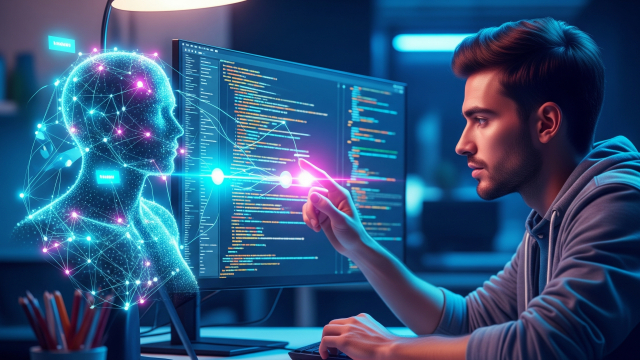
Down here in Santa Catarina, when we think of partnerships, we might picture a good chimarrão shared between friends or the perfectly synchronized moves of a dança de salão.
But in the ever-evolving world of tech, a new kind of partnership is emerging, one that involves lines of code, complex algorithms, and a dash of something that feels almost like magic: Artificial Intelligence.
For years, software development felt like a purely human endeavor. Late nights fueled by strong coffee (or maybe a few cachaças, depending on the deadline), the satisfying click-clack of keyboards, and the occasional frustrated sigh when a bug decided to play hide-and-seek in a million lines of code.
But the landscape is shifting, and AI is stepping onto the stage, not to replace developers (at least not entirely, despite what some doomsayers might predict), however to become a powerful collaborator, a tireless assistant, and sometimes, even a source of surprisingly insightful suggestions.
I remember when I first heard about AI writing code. My initial reaction was a healthy dose of skepticism mixed with a sprinkle of fear. Would these silicon brains steal our jobs? Would we all be replaced by emotionless coding robots churning out perfect software at lightning speed? Well, the reality, as it often does, is proving to be more nuanced and, frankly, quite exciting.
My bot wrote a poem (okay, maybe just a function, but still!)
My first real encounter with AI in a coding context was when I was playing around with one of those AI-powered code completion tools. I was writing a fairly repetitive function, something that involved iterating through a list and performing a similar operation on each item. Boredom was setting in, my fingers were getting tired, and I half-jokingly typed a comment describing what I wanted the rest of the function to do. To my surprise (and a little bit of genuine astonishment), the AI popped up with the exact code I was thinking of! It wasn’t perfect, I still had to review it, but it saved me a significant chunk of time and mental energy.
It felt a bit like having a super-smart pair programmer who could anticipate my next move. Now, I know it wasn’t sentient or sipping a virtual tereré beside me, but it definitely felt like a glimpse into the future of software development.
How AI is weaving its way into the fabric of software development
So, how exactly is AI making its presence felt in the software development lifecycle? It’s not just about suggesting lines of code; its influence is much broader and deeper.
Automating Repetitive Tasks: Let’s face it, not all coding tasks are glamorous. There’s a fair amount of boilerplate code, repetitive testing, and tedious configuration involved. AI is proving incredibly useful in automating these mundane tasks, freeing up developers to focus on more complex problem-solving and creative aspects of their work. Think about AI-powered tools that can automatically generate unit tests, refactor code for better readability, or even deploy applications.
Intelligent Code Completion and Suggestion: This is perhaps one of the most visible ways AI is impacting developers’ daily workflows. Tools that use machine learning to analyze code patterns and suggest relevant completions or even entire code snippets are becoming increasingly sophisticated. They can learn from your coding style, the context of your project, and vast repositories of open-source code to provide surprisingly accurate and helpful suggestions, boosting productivity and reducing typos.
Smarter Debugging and Error Detection: We’ve all spent countless hours hunting down elusive bugs in our code. AI is starting to lend a hand in this frustrating but a key process. AI-powered tools can analyze code for potential vulnerabilities, identify patterns that often lead to errors, and even suggest fixes based on past debugging experiences. This can significantly reduce the time spent debugging and improve the overall quality and stability of the software.
Enhanced Code Review: Code reviews are decisive for maintaining code quality and catching potential issues early on. AI can augment this process by automatically identifying potential style violations, security flaws, or areas of concern based on established best practices and machine learning models trained on large codebases. This allows human reviewers to focus on more complex logic and architectural considerations.
Generating Documentation: Writing documentation is often the task that developers love to hate. AI could potentially alleviate this pain point by automatically generating documentation based on the code itself, including function descriptions, parameter details, and even usage examples. While fully automated, high-quality documentation might still be a way off, AI can certainly help streamline the process.
Personalized Learning and Skill Development: AI-powered platforms can analyze a developer’s coding patterns and identify areas where they might need to improve. They can then recommend relevant learning resources, tutorials, or coding challenges tailored to their specific needs, helping developers grow their skills more effectively.
Improving Software Design and Architecture: While still in its early stages, AI is starting to be used to analyze existing software architectures and suggest potential improvements in terms of scalability, performance, and maintainability. This could lead to more robust and future-proof software systems.
Natural Language Programming (in the Future): Imagine being able to describe the software you want to build in plain English (or Portuguese!) and having an AI system generate the code for you. While we’re not quite there yet, advancements in natural language processing and code generation are hinting at this possibility in the future. This could potentially democratize software development and make it accessible to a wider range of people.
The human touch still matters (maybe more than ever)
Despite all the amazing capabilities of AI in software development, it’s decisive to remember that the human element remains big. AI tools are powerful assistants, but they are not (yet) creative problem-solvers or strategic thinkers in the same way that humans are.
Understanding the “Why”: AI can help write code, but it doesn’t understand the underlying business logic, user needs, or the broader context of the project in the same way a human developer does. We still need human developers to define the requirements, design the overall architecture, and ensure that the software truly meets the intended purpose.
Creativity and Innovation: True innovation often comes from unexpected connections and out-of-the-box thinking. While AI can identify patterns and suggest improvements, it’s human creativity that often leads to truly groundbreaking solutions.
Ethical Considerations: As AI becomes more integrated into software development, ethical considerations become increasingly important. Ensuring fairness, transparency, and accountability in AI-powered tools requires human oversight and careful consideration.
The “Human” in Human-Computer Interaction: Ultimately, software is built for humans. Understanding user behavior, designing intuitive interfaces, and ensuring a positive user experience still requires empathy and a human-centered approach.
The future is collaborative: Humans and AI working together
The future of software development is likely to be a collaborative one, where human developers and AI tools work together in synergy.
AI can handle the more tedious and repetitive tasks, augment our abilities, and provide valuable insights, while human developers can focus on the higher-level strategic thinking, creative problem-solving, and ensuring the ethical and human-centered aspects of software development.
Think of it like this: AI can be the tireless intern who can churn through mountains of data and generate boilerplate code, while the experienced developer acts as the architect and the visionary, guiding the project and making the critical decisions.
It’s a partnership that has the potential to make software development faster, more efficient, and ultimately, more innovative.
So, while I might not be handing over my coding keyboard to a robot anytime soon, I’m definitely excited about the possibilities that AI brings to the world of software development.
It’s a new era of collaboration, one where humans and machines can work together to build amazing things. And who knows, maybe one day my AI assistant will even be able to brew me a perfect virtual cafezinho while I debug my code!